FOR ANY QUERY
OFFICE NUMBER
+92 324 4498948
+92 301 4232009
mail us
info@awaisinternational.com
Location
Office # 915, 9th Floor, Al-Hafeez Executive, Block C3, Gulberg 3, Lahore, Punjab, Pakistan.
The landscape of manufacturing and prototyping is undergoing a seismic shift. In the heart of Pakistan’s industrial and creative sectors, the 3D printer has emerged as a cornerstone of the Fourth Industrial Revolution. No longer a futuristic concept reserved for high-end research labs, 3D printing technology is now accessible to engineers, architects, educators, and hobbyists across the country.
At Awais International, we understand that navigating the complexities of additive manufacturing can be daunting. Whether you are searching for the best 3D printer price in Pakistan or seeking to understand the intricacies of a 3D digital printing machine, this comprehensive guide explores the elite perks of adopting this technology and the current market dynamics in 2026.
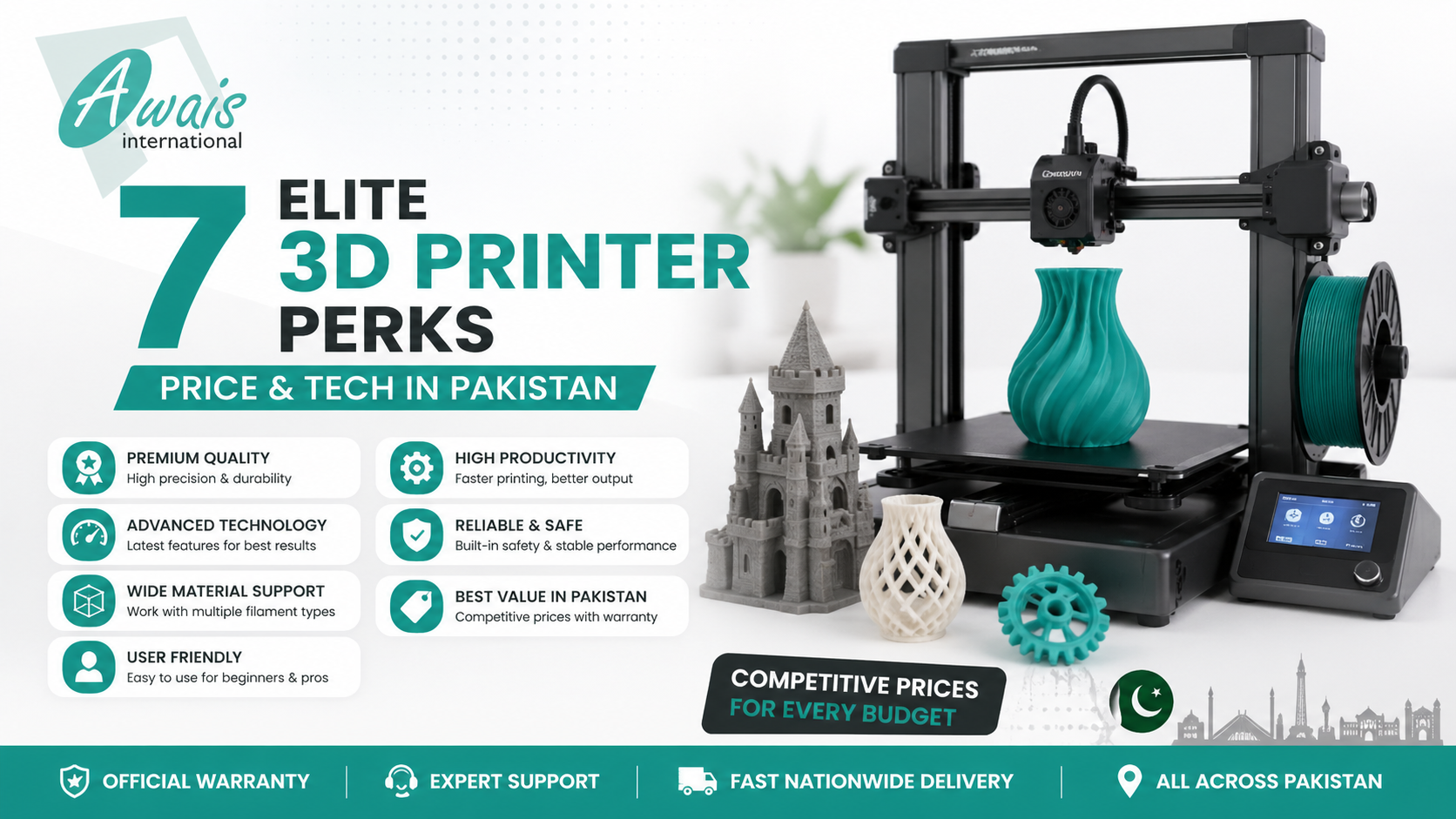
1. Defining the Future: What is 3D Printing?
Before diving into the elite perks, one must grasp the fundamental 3d printing definition. At its core, 3D printing—also known as additive manufacturing—is the process of creating three-dimensional solid objects from a digital file. Unlike traditional subtractive manufacturing (which carves material away), a 3d printer builds the object layer by layer.
This 3d printing technology utilizes various materials, from PLA and ABS filaments to sophisticated resins and metal powders, allowing for the creation of complex geometries that were previously impossible to manufacture.
2. Rapid Prototyping and Accelerated Innovation
The primary perk of utilizing a 3d printer machine in Pakistan is the drastic reduction in “time-to-market.” For businesses in Lahore, Karachi, and Islamabad, the ability to iterate designs in-house is a game-changer.
Speed: Move from a CAD model to a physical prototype in hours, not weeks.
Precision: Achieve micron-level accuracy with advanced 3d digital printing machine models.
Cost-Efficiency: Reduce the waste associated with traditional molding and machining.
As a top wholesaler of printers in Pakistan, we provide the hardware necessary to keep Pakistani innovators at the forefront of global design trends.
3. Sophisticated 3D Printing Technology
The evolution of 3d printing technology has introduced several modalities to the Pakistani market:
FDM (Fused Deposition Modeling): The most common and cost-effective method using thermoplastic filaments.
SLA (Stereolithography): Uses light to cure liquid resin into hardened plastic, offering incredible detail.
SLS (Selective Laser Sintering): A high-end industrial process using lasers to fuse powdered material.
Understanding these technologies is crucial when evaluating the 3d printer machine price in Pakistan, as industrial-grade SLS machines command a premium compared to desktop FDM units.
4. Market Accessibility: 3D Printer Price in Pakistan
One of the most significant “elite perks” today is the democratization of price. In 2026, the 3d printer price in Pakistan has stabilized, making it viable for small-scale entrepreneurs.
For those on a strict budget, finding the best printer under 30000 PKR in Pakistan is now a reality. While entry-level hobbyist machines are affordable, professional-grade 3d digital printing machine setups for dental or engineering applications are also becoming more competitively priced due to the efforts of a renowned importer of printers in Lahore.
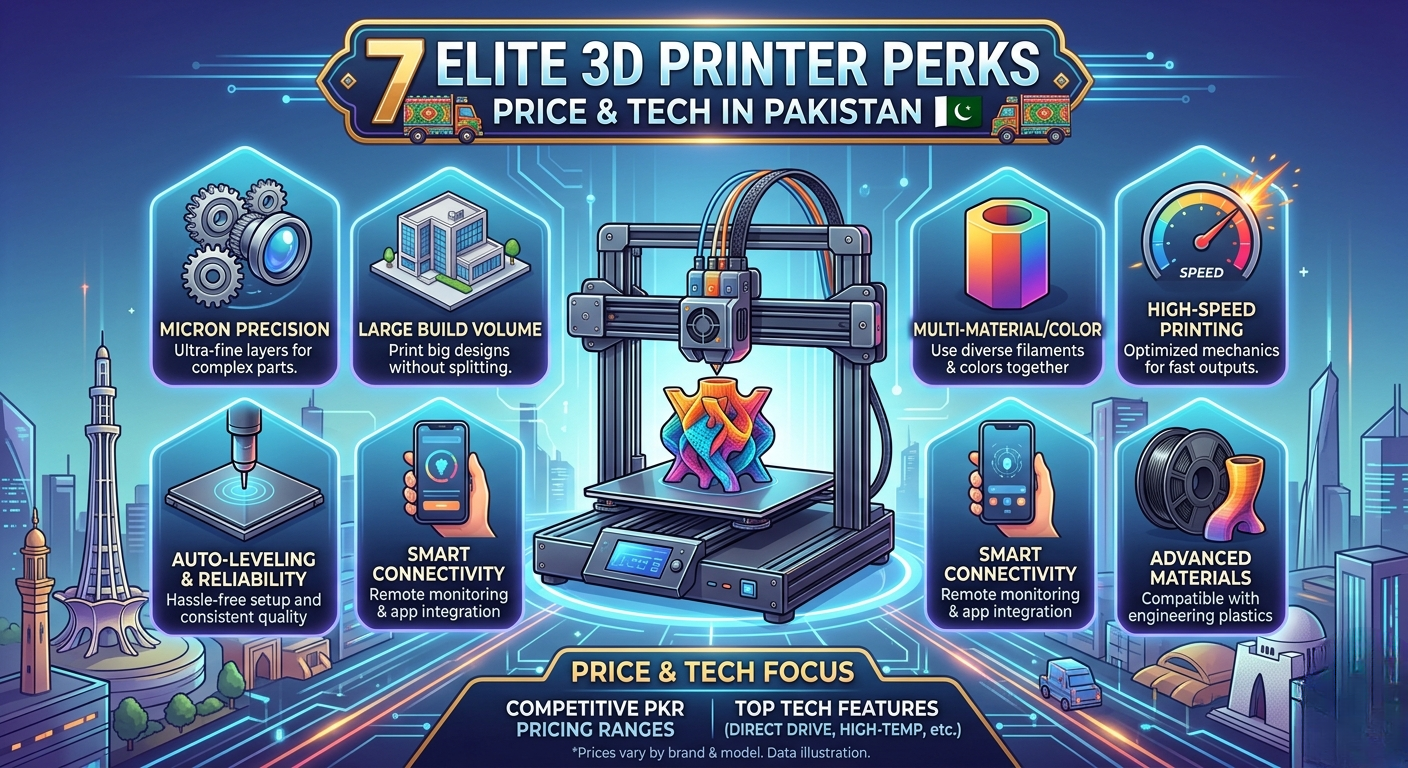
5. 3D Printing Advantages and Disadvantages
To make an informed investment, one must weigh the 3d printer advantages and disadvantages.
Advantages:
Customization: Create “one-of-a-kind” parts without expensive tooling.
Complexity for Free: Intricate internal structures do not increase the cost of printing.
Sustainability: Minimal material waste compared to CNC machining.
Disadvantages:
Post-Processing: Many prints require sanding, painting, or support removal.
Material Limitations: While expanding, the range of printable materials is still less than traditional manufacturing.
Production Speed: While fast for prototypes, it is slower than injection molding for high-volume mass production.
6. Local Support and Supply Chain
The growth of 3d printing in Pakistan is heavily dependent on a robust supply chain. Investing in a machine is only half the battle; sourcing high-quality filaments, resins, and spare parts is vital.
As a leading importer of printers in Pakistan, Awais International ensures that our clients are never stranded. We bridge the gap between global tech giants and the local Pakistani market, providing the technical support required for high-stakes industrial applications.
7. The Rise of 3D Digital Printing Machines in Industry
The term 3d digital printing machine often refers to high-end systems integrated into digital workflows. In Pakistan, we are seeing these used in:
Healthcare: 3D-printed prosthetics and dental crowns tailored to individual patients.
Architecture: Highly detailed scale models for real estate developments in Bahria Town and DHA.
Education: STEM labs in universities across Punjab and Sindh are adopting 3D printers to foster creative engineering.
Why Choose Awais International?
We are not just a vendor; we are your partners in innovation. With a deep understanding of the 3d printer machine price in Pakistan and the technical nuances of various printing modalities, we provide curated solutions that fit your specific needs.
Contact Information
For personalized quotes or to visit our experience center, please use the following details:
Call us: +923244498948
Telephone line: 0423-6408266
Email us: info@awaisinternational.com
Office Address: Office # 915, 9th Floor, Al-Hafeez Executive, Block C3, Gulberg 3, Lahore, Punjab, Pakistan.
Frequently Asked Questions (FAQs)
Q1: What is the average 3D printer price in Pakistan for a beginner?
For beginners and students, a reliable FDM 3D printer can start from as low as 30,000 PKR to 65,000 PKR, depending on the build volume and features.
Q2: Can I use a 3D printer for commercial manufacturing in Pakistan?
Absolutely. Many Pakistani startups use a “print farm” (multiple 3D printers) to manufacture custom products like mobile covers, jewelry molds, and specialized industrial components.
Q3: What materials are commonly used in 3D printing in Pakistan?
The most common materials are PLA (easy to print, biodegradable) and ABS (durable, heat-resistant). However, professional users also utilize PETG, TPU (flexible), and Resin for high-detail work.
Q4: Is 3D printing technology difficult to learn?
While there is a learning curve regarding 3D modeling (CAD) and “slicing” software, the actual operation of a modern 3d printer is becoming increasingly user-friendly and automated.
Q5: Where can I get technical support for my 3D printer in Lahore?
Awais International provides comprehensive support and consultancy at our Lahore office in Gulberg 3. We assist with setup, maintenance, and material sourcing for all our clients.