
For Any Query

Every device in your office, from laptops to CCTV cameras to the billing computer at the front desk, is connected to the internet. That connection helps your business grow, but it also gives attackers a path to your data. A firewall is the first thing standing between that path and your private network.
So what exactly is a firewall, and does your business really need one? In this guide, you’ll learn how a firewall works, the different types available, how a firewall differs from the internet filtering many people in Pakistan know about, and how to pick the right one for your office, shop, or warehouse. If you are setting up or upgrading your IT infrastructure, Awais International offers business-grade networking equipment, and we’ll point you to the right resources along the way.
What Is a Firewall and Why Does It Matter?
A firewall is a security system that monitors and controls incoming and outgoing network traffic based on a set of security rules. It acts as a barrier between a trusted internal network and untrusted networks such as the internet.
The US National Institute of Standards and Technology (NIST) describes a firewall in a very similar way: a gateway that limits access between networks according to a defined policy. You can read their full definition in the NIST Computer Security Resource Center glossary.
Think of it like the security guard at your office building. The guard checks who is coming in, who is going out, and whether they have permission. If someone looks suspicious or is not on the list, they are turned away.
Why Every Business Needs a Firewall
- Small offices are common targets because attackers assume their security is weak.
- One infected computer can spread malware to every device on the network.
- Customer records, invoices, and supplier details are valuable and easy to steal.
- Downtime from an attack can cost more than the firewall itself.
How Does a Firewall Work?
A firewall inspects data packets, which are small chunks of information traveling across your network. For each packet, it checks details such as where it came from, where it is going, and which port or application it uses. Then it compares those details against its rules and decides to allow, block, or log the traffic.
The Basic Firewall Process
- A packet arrives at the firewall from the internet.
- The firewall checks it against the rule set.
- Approved traffic passes through to your internal network.
- Suspicious or unauthorized traffic is dropped.
- The event is recorded so your IT team can review it later.
Modern firewalls go further. They can recognize applications, scan for known threats, and inspect encrypted traffic, which makes them far more capable than the simple packet filters of the past.
Essential Benefits of Using a Firewall
- Blocks unauthorized access. Outsiders cannot freely connect to your servers, computers, or cameras.
- Stops malware before it spreads. Many firewalls detect and block known malicious files and websites.
- Protects sensitive business data. Financial records and customer details stay inside your network.
- Controls employee internet use. You can restrict risky websites and limit bandwidth-heavy applications.
- Secures remote work. A firewall with VPN support lets staff connect safely from home or while traveling.
- Provides visibility. Logs show what is happening on your network, which helps you spot problems early.
- Supports compliance and trust. Customers and partners feel safer dealing with a business that takes security seriously.
Different Types of Firewall for Network Security
Not all firewalls work the same way. Here are the main types you will come across.
Packet-Filtering Firewall
The simplest type. It checks basic information like IP addresses and ports. It is fast but offers limited protection on its own.
Stateful Inspection Firewall
This type tracks active connections and understands context, so it can tell whether incoming traffic is a legitimate response to something your network requested.
Proxy Firewall
It sits between users and the internet, receiving requests on their behalf. This hides your internal devices and allows deeper content checking.
Next-Generation Firewall (NGFW)
An NGFW combines traditional firewall features with intrusion prevention, application awareness, and advanced threat detection. For a clear technical overview, the Palo Alto Networks firewall guide is a helpful reference. Most growing businesses today are better served by this type
Hardware Firewall vs Software Firewall
This is one of the most common questions buyers ask, and the honest answer is that many businesses benefit from both.
What Is a Hardware Firewall?
A physical device installed between your router and your internal network. It protects every connected device at once, handles heavy traffic well, and does not slow down individual computers.
What Is a Software Firewall?
A program installed on a single computer or server, like the built-in Windows firewall. It protects that one device and is useful for adding a second layer of defense.
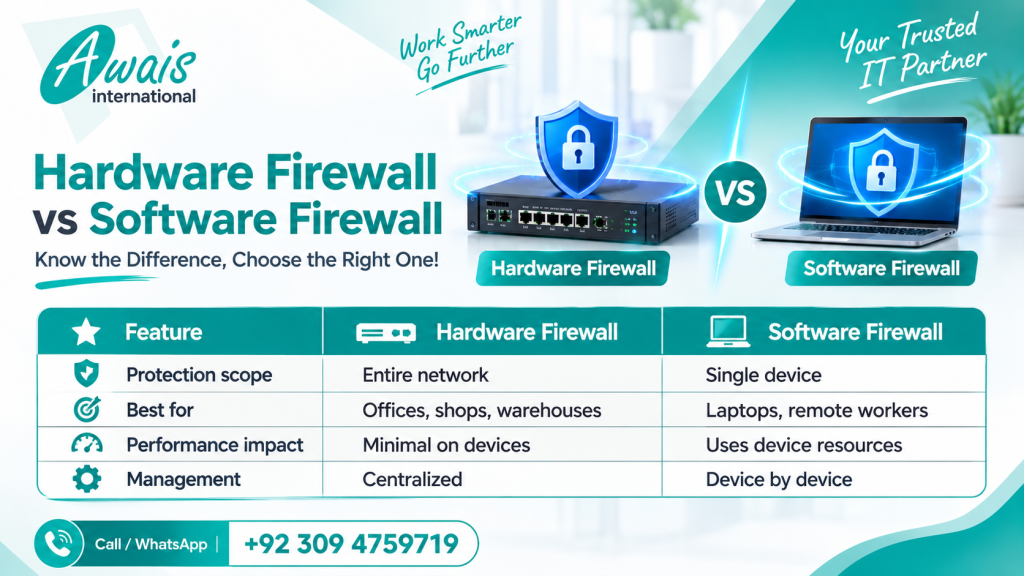
For any business with more than a few computers, a dedicated hardware firewall is the stronger foundation. You can explore networking equipment on the Awais International networking category to compare options.
What Is an Internet Firewall in Pakistan?
Searching for an internet firewall in Pakistan can lead to two quite different topics, so it helps to separate them.
National-Level Pakistan Internet Firewall
The Pakistan internet firewall is often discussed in news and public debate as a system for managing and filtering internet traffic at the national level. It operates at the network infrastructure of internet providers and is outside the control of individual businesses.
Your Own Business Firewall
This is the security device you install in your office. You decide the rules, you see the logs, and you protect your own data. This is what this guide focuses on.
The key difference is control. A national filter affects everyone using a particular network. A business firewall is a tool you configure for your own security needs.
Why Local Conditions Matter in Pakistan
- Shared or low-cost internet connections with weak default security
- Staff using personal phones and laptops on the office Wi-Fi
- Frequent power cuts and equipment resets that can wipe poorly saved settings
- Limited in-house IT support in small and medium businesses
A firewall with stable power backup, regular firmware updates, and a clear rule set solves most of these problems.
How to Choose the Right Firewall for Your Business
Choosing a firewall does not have to be complicated. Work through these questions first.
- How many users and devices do you have? A five-person office and a 100-person warehouse need very different capacity.
- What is your internet speed? Your firewall should handle your full bandwidth without becoming a bottleneck.
- Do you need remote access? If staff work from home, look for built-in VPN features.
- Do you run servers or CCTV systems? Security cameras and recorders are often targeted, so segmenting them from your main network is smart. Our guide to CCTV cameras for business security explains how they fit into a secure setup.
- Who will manage it? If you have no IT staff, choose a model with simple setup and cloud-based management.
- What is your budget? Consider support, licensing, and updates, not just the purchase price.
Best Business Firewall Solutions and Features
Key Features to Look For
- Intrusion prevention (IPS): Detects and stops known attack patterns.
- VPN support: Allows secure remote connections.
- Web and content filtering: Blocks harmful or unproductive websites.
- Application control: Manages which programs can use the network.
- Threat intelligence updates: Keeps protection current against new risks.
- Easy reporting: Clear logs and alerts you can actually understand.
- Scalability: Room to grow as your team expands.
Build a Complete Network Security Setup
A firewall works best as part of a complete setup. Pair it with quality routers and network switches, a reliable UPS for power protection, and secure business laptops and computers so there are no weak links. You can browse the full range at the Awais International homepage, where IT equipment and business solutions are available for customers across Pakistan.
Frequently Asked Questions
What is a firewall in simple words?
A firewall is a security barrier that checks the data entering and leaving your network and blocks anything unsafe or unauthorized. It can be a physical device, a software program, or both.
Is a firewall the same as antivirus?
No. A firewall controls network traffic and stops unauthorized connections. Antivirus software scans files and programs on a device to find and remove malware. They do different jobs, and you should use both.
Do small businesses need a firewall?
Yes. Small businesses are often targeted because they tend to have weaker protection. Even a basic hardware firewall greatly reduces your risk.
Can a firewall slow down my internet?
A properly sized firewall should not noticeably slow your connection. Problems usually happen when the device is too small for your bandwidth or the rules are poorly configured.
How often should I update my firewall?
Check for firmware and security updates at least once a month, and review your rules every few months. Outdated firewalls leave gaps that attackers know how to exploit
Conclusion: Protect Your Network Before Problems Start
A firewall is one of the simplest and most effective steps you can take to protect your business. It blocks unauthorized access, limits the spread of malware, and gives you clear visibility into your network. The right choice depends on your size, your budget, and how your team works, but doing nothing is the riskiest option of all.
Ready to secure your office? Visit Awais International to explore business networking equipment, or contact our team for guidance on choosing the right firewall for your setup. Protect your network today, before an attack forces the decision for you
Get a Free Quote
Fill in the form our team will get back to you with the next steps.
+92 309 4759719
+92 324 449 8948
info@awaisinternational.com
Office # 915, 9th Floor, Al-Hafeez Executive, Block C3, Gulberg 3, Lahore, Punjab, Pakistan