
FOR ANY QUERY
OFFICE NUMBER
+92 324 4498948
+92 301 4232009
mail us
info@awaisinternational.com
Location
Office # 915, 9th Floor, Al-Hafeez Executive, Block C3, Gulberg 3, Lahore, Punjab, Pakistan.
11 Powerful Dell Latitude Laptops That Redefine Business Performance
I’ve watched people spend money on the wrong laptop more times than I can count. They walk in, get dazzled by a thin chassis or a big RAM number on the sticker, buy it, and three months later they’re complaining that it overheats, the battery’s already struggling, or it can’t handle more than four browser tabs without slowing to a crawl.
Then those same people eventually end up with a Dell Latitude. And they stop complaining.
That’s not a coincidence. The Latitude lineup has been quietly earning that reputation for years — not through flashy marketing or celebrity endorsements, but through machines that just work. Day after day. Meeting after meeting. Deadline after deadline.
But here’s the thing nobody tells you upfront: not every Latitude is the same. There’s a big difference between the entry-level models and the premium 7-series. There’s a difference between an 8th gen and an 11th gen processor that you’ll actually feel in daily use. And there’s definitely a difference between buying from a trustworthy dealer and taking a gamble on a random listing somewhere.
So let’s go through 11 models properly. No fluff. Just honest takes on what each one actually does well, where it falls short, and who should genuinely be looking at it.
Why the Dell Latitude Still Makes Sense in Pakistan's Market
Before jumping into individual models, it’s worth asking — why Latitude specifically?
Pakistan’s laptop market has exploded with options. Budget brands, grey imports, locally assembled machines that look fine until they don’t. So why do experienced buyers, IT managers, and corporate purchasing teams keep circling back to the Dell Latitude series?
A few reasons that actually hold up under scrutiny.
First, durability. These machines are MIL-STD-810G certified — tested against dust, humidity, drops, extreme temperatures, and vibration. That’s not a marketing phrase Dell invented. It’s a legitimate military-grade standard that most consumer laptops never bother pursuing because the testing costs money. Latitudes go through it because they’re designed for environments where laptops take real punishment.
Second, the long game. A budget laptop at 40,000 PKR that needs replacing in two years costs more than a Latitude at 65,000 PKR that runs well for six. People who’ve done this math tend to stop buying cheap.
Third — and this matters a lot in Pakistan — genuine availability through dealers like Awais International means you actually know what you’re getting. No mystery components, no undisclosed refurbishment work, no battery that’s on its last legs hidden behind a clean exterior.
Now, the models.
Dell Latitude 5400 The One That Just Gets on With It.
Nobody buys the Dell Latitude 5400 to impress anyone. That’s completely fine — it’s not trying to impress anyone either.
Intel 8th generation processor, up to 16GB RAM, PCIe NVMe SSD storage, 14-inch FHD display. Everything about this machine is built around doing the job without getting in the way. Boot times are fast. Applications open quickly. The keyboard has genuinely good travel for a laptop in this category — better than a lot of machines that cost more.
Where it earns its money is in consistency. It doesn’t start throttling after an hour of solid use. It doesn’t randomly lag during video calls. It doesn’t develop the kind of slow creep that makes you want to throw your laptop out a window eighteen months into ownership.
For office work, document management, email, and standard business applications — this machine is exactly what most people actually need, priced at a point that doesn’t require serious justification.
Right for: Office workers, admin staff, anyone who needs something dependable and doesn’t want to overpay for specs they’ll never use.
Dell Latitude 5420 This Is the Upgrade Worth Paying For
Not every newer model justifies the price jump. The Dell Latitude 5420 does.
Intel 11th generation Tiger Lake processors make a real, noticeable difference — not just on benchmarks but in how the machine feels during actual use. Thunderbolt 4 is a bigger deal than it sounds if you ever connect external monitors, use fast storage drives, or want a proper docking station setup. These aren’t edge-case features — they’re things professionals use every day.
The chassis got refined too. Slimmer. Feels more solid in hand. Touch display is available if that’s your thing.
The practical reason to choose the 5420 over the 5400 is longevity. If you’re keeping a laptop for four or five years — which is smart financially — buying 11th gen architecture and Thunderbolt 4 now means you won’t feel outdated two years in. It connects naturally to Dell’s broader performance ecosystem if you’re thinking beyond just the laptop itself.
Right for: Professionals who plan ahead and want hardware that stays relevant for the full lifespan of their purchase.
Dell Latitude 5490 One Feature That Changes How You Work
There’s a version of the Dell Latitude 5490 with built-in 4G LTE. If you work in Pakistan and move between locations regularly, stop here and pay attention to this one.
Wi-Fi at client sites is often locked or throttled. Mobile hotspots drain your phone and add a step to getting online. In smaller cities and on the road between them, reliable internet is genuinely inconsistent. The 5490 with a SIM slot means you put a card in once and you’re online wherever you go — no friction, no juggling, no depending on someone else’s network.
Beyond that headline feature, it’s a solid machine. Intel 8th gen, proper port selection, SD card reader, clean 14-inch display. Battery covers a normal workday. Nothing about it is going to surprise you — except that 4G connectivity, which field workers in Pakistan tend to call genuinely life-changing for their workflow.
Right for: Consultants, field sales teams, remote workers — anyone whose office changes location regularly.
Dell Latitude 7400 Light Enough to Actually Carry Every Single Day
There’s a type of laptop that lives permanently on a desk because the owner got tired of carrying it. The Dell Latitude 7400 is not that laptop.
Carbon fiber lid, magnesium alloy chassis, under 1.4kg. You genuinely forget it’s in your bag. That matters more than specs pages suggest — a laptop you actually carry is infinitely more useful than one you leave at the office because it’s a pain.
Intel 8th gen Whiskey Lake processors handle professional workloads comfortably. Display options go up to 4K. Battery hits 10 to 12 hours in real use, not lab conditions. The ExpressConnect Wi-Fi automatically finds the strongest available network when you move between locations — a small detail that removes a recurring annoyance for frequent travelers.
Every design choice here makes sense for a professional who moves a lot. Nothing bloated, nothing unnecessary.
Right for: Business travelers, executives, anyone who’s tired of their laptop being a burden to carry.
Dell Latitude 7420 When Your Work Actually Demands It
Some people genuinely stress their laptops. Running analytics tools in the background, jumping between ten applications, handling video calls while processing data, presenting from the same machine they’re using to work. The Dell Latitude 7420 is built for those people specifically.
Intel 11th generation processors with Thunderbolt 4 give it real headroom. The thermal management is notably better than the 7400 — it runs cooler under sustained load, which becomes important during those extended work sessions that run five or six hours without a break.
The 2-in-1 form factor deserves mention here too. If you ever annotate documents with a stylus, sketch out ideas, or present from a tablet position — this works well. Not in the awkward, compromised way some convertibles feel. The hinge is solid and the modes are genuinely practical.
For anyone looking at Dell Core i7 options in Pakistan, the 7420 in an i7 configuration is consistently one of the most balanced premium machines available locally.
Right for: Data professionals, heavy multitaskers, anyone who genuinely pushes their hardware during a normal working day.
Dell Latitude 7480 — Older, Cheaper, Still Honest
Direct question: should you buy a laptop that’s a few generations old?
For the Dell Latitude 7480, yes — with realistic expectations.
The hardware is Intel 7th and 8th gen, which tells you it’s not new. But what was built into this machine from day one — the chassis quality, the keyboard, the display, the port layout — those things held up. The keyboard specifically gets mentioned often by people who’ve used a lot of laptops. It’s good. Better than many newer machines that seem to have forgotten that people actually type on keyboards.
Prices have dropped significantly since launch, which is the whole argument. For businesses buying several units, or individuals with a firm budget ceiling, the 7480 covers standard professional work — Office applications, communication tools, browser-based platforms — without making you feel like you compromised on quality.
Be honest with yourself about its limits though. If you’re running heavy workloads, you’ll feel the age. For standard daily business use, it earns its place.
Right for: Budget-conscious buyers, small businesses equipping teams, professionals who need quality without premium pricing.
Dell Latitude 7490 The Answer Most Experienced Buyers Land On
Ask around. Talk to IT managers who’ve bought and managed hundreds of laptops. Ask experienced buyers who’ve owned multiple machines across different brands. Eventually, the Dell Latitude 7490 comes up as the reference point.
Not because it’s exciting. Because it works. Consistently. Over years.
Intel 8th gen processors, optional 4G LTE, a keyboard that handles long days of typing without punishing your hands, a bright accurate display, and build quality that looks decent even after two years of daily use. Battery performance doesn’t fall off a cliff after six months — it stays consistent in a way that cheaper machines simply don’t.
The real value of the 7490 in a business context is hard to put a number on. Machines that don’t create IT support tickets, don’t overheat at inconvenient times, don’t develop random slowdowns — that reliability has a direct impact on productivity. Companies that track these things buy the 7490 and keep buying it for that reason.
If you’re choosing one Latitude for serious professional use and you want to stop thinking about it after the purchase — this is the one.
Right for: Corporate professionals, enterprise buyers, anyone who values long-term reliability over having the newest specs.
Dell Latitude E5470 The Refurbished Market's Quiet Workhorse
The Dell Latitude E5470 runs Intel 6th generation processors. Yes, it’s older. No, that doesn’t automatically make it a bad buy.
When this machine launched, it built a reputation for toughness and dependability that lasted. MIL-STD-810G certified, solid chassis, practical keyboard, sensible port layout. Those qualities don’t evaporate when a newer model comes out — they just become available in the refurbished market at a lower price.
For students managing university workloads on a limited budget, or small operations that need functional machines without a serious capital outlay, the E5470 handles what’s asked of it without drama. Standard business software, research, document work, video calls — it covers the basics reliably.
The non-negotiable condition: buy from someone who actually tests their refurbished stock and stands behind it. A refurbished Latitude with a tired battery and misrepresented specs isn’t a deal. It’s a problem that shows up two months after you stop being able to return it.
Right for: Students, first-time buyers, budget shoppers who want proven build quality without the new-machine price.
E5470 vs 5490 — Let's Just Be Direct About This
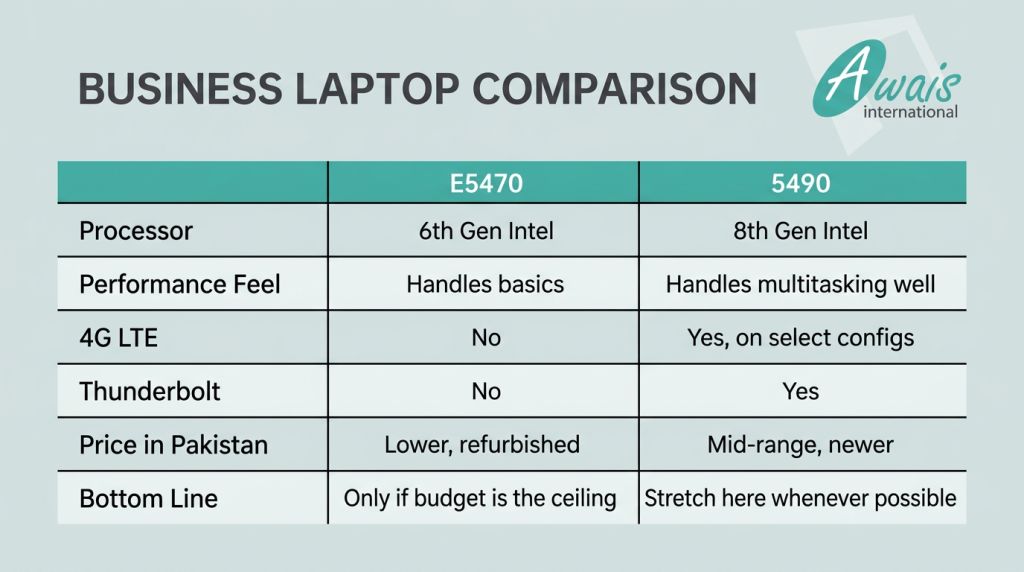
Honest answer: buy the 5490 if you can. The performance difference is real. The connectivity options are more practical for how people actually work in Pakistan. And you’re getting a machine with considerably more life ahead of it. The E5470 is the right call only when the budget genuinely doesn’t allow for anything newer.
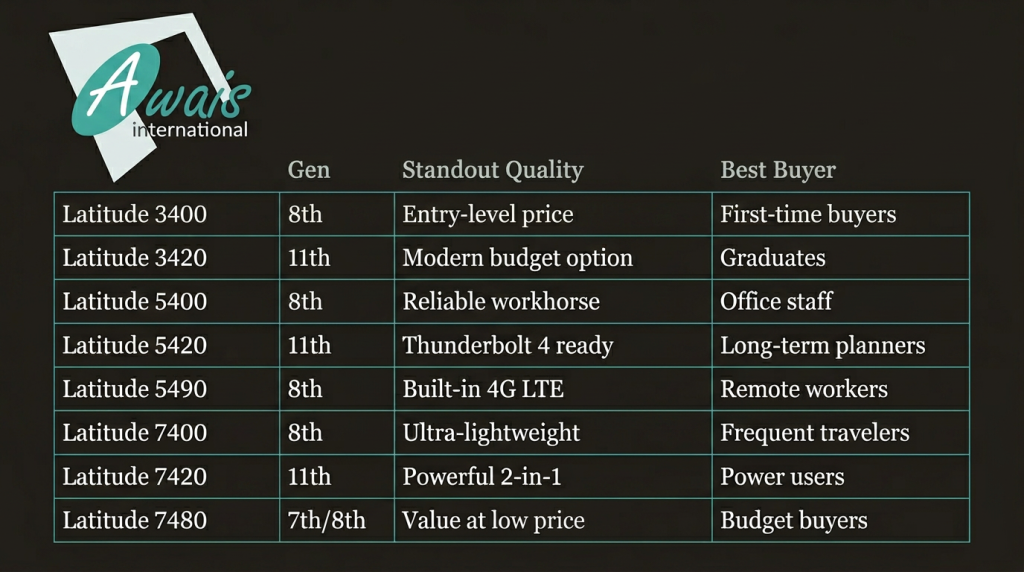
All 11 Models — Quick Reference
Students in Pakistan — Which One Makes Sense?
Students need something they’ll actually carry, that gets through lectures and library sessions on one charge, and that doesn’t require a second mortgage to buy.
The 5400 and E5470 both work here. They handle everything a student actually needs — assignments, research, presentations, calls. For students who can push the budget slightly further, the 5420 is the smarter choice long-term. The 11th gen platform stays competitive through a full degree program and well beyond it.
There’s also a good range of Dell laptops in the 20,000 to 30,000 PKR range worth looking at if budget is genuinely tight.
Corporate Professionals Narrow It Down to These Three
For serious professional use, it comes down to the 7490, 7420, and 5490.
The 7490 wins on reliability and proven track record. The 7420 wins if you need current-generation specs and flexible form factor. The 5490 wins if connectivity is the primary pain point in how you currently work.
Businesses in Islamabad can source genuine stock through Dell authorized dealers who handle bulk orders and warranty coverage properly — important when you’re outfitting a team rather than just yourself.
Buying Genuine — This Part Actually Matters
Pakistan’s laptop market has a genuine problem with misrepresented hardware. Grey imports, replaced components passed off as original, refurbished machines with dead batteries hiding behind clean shells. It happens regularly enough that buying from an unknown source is a real risk.
Awais International has spent years building a reputation as one of Pakistan’s most reliable IT suppliers. They stock genuine Dell Latitude units across the full price range — from affordable refurbished options to premium new configurations. Whether you’re in Lahore looking for a Dell laptop, comparing Dell computers across Pakistan, checking Core i5 prices, or even curious about Dell gaming options in Lahore — genuine stock with proper support is what you get.
A cheaper price from an unknown seller almost never stays cheaper once you factor in what goes wrong.
Frequently Asked Questions
Can I use a Dell Latitude for personal stuff, not just work?
Yes, without any real trade-off. Streaming, casual browsing, personal projects — Latitudes handle all of it. The build quality means they outlast most consumer laptops too, making them smart personal investments.
How long will these actually last with normal use?
Five to seven years is realistic for most models. Premium 7-series machines often push past that — which is exactly why used 7490s still sell for decent money long after launch.
Is buying refurbished in Pakistan risky?
Only if you buy from the wrong source. From a dealer who tests and certifies their stock — models like the 7480, 7490, and E5470 are genuinely strong refurbished buys. Verify battery health. Get a warranty, even a short one.
What really separates 5-series from 7-series?
Build materials and portability, mainly. The 7-series uses carbon fiber and magnesium alloy — lighter, tougher. Display options are better. Security features are more comprehensive. Performance overlaps depending on config, but the physical quality gap is consistent.
Can I upgrade RAM and storage later?
Most Latitudes — especially the 5400, 5420, 5490, 7480, and 7490 — support upgrades. That’s a genuine advantage over sealed consumer laptops where your only upgrade option is buying something new entirely.
Final Honest Summary
There’s a Dell Latitude for every realistic work situation in Pakistan — the question is just matching the machine to what you actually need.
7490 — buy it if reliability over years is your top priority. 5490 — buy it if you work across multiple locations and need consistent connectivity. 7420 — buy it if you push your hardware hard and want modern specs. 7480 or E5470 — buy them if budget is genuinely tight and you want proven quality at a lower price. 5420 — buy it if you’re thinking four or five years ahead and want hardware that stays relevant.
None of these are bad choices. Some are just better for specific situations than others.
Visit Awais International — explore the full Dell Latitude range, ask their team what fits your situation, and buy from people who actually know what they’re selling.